
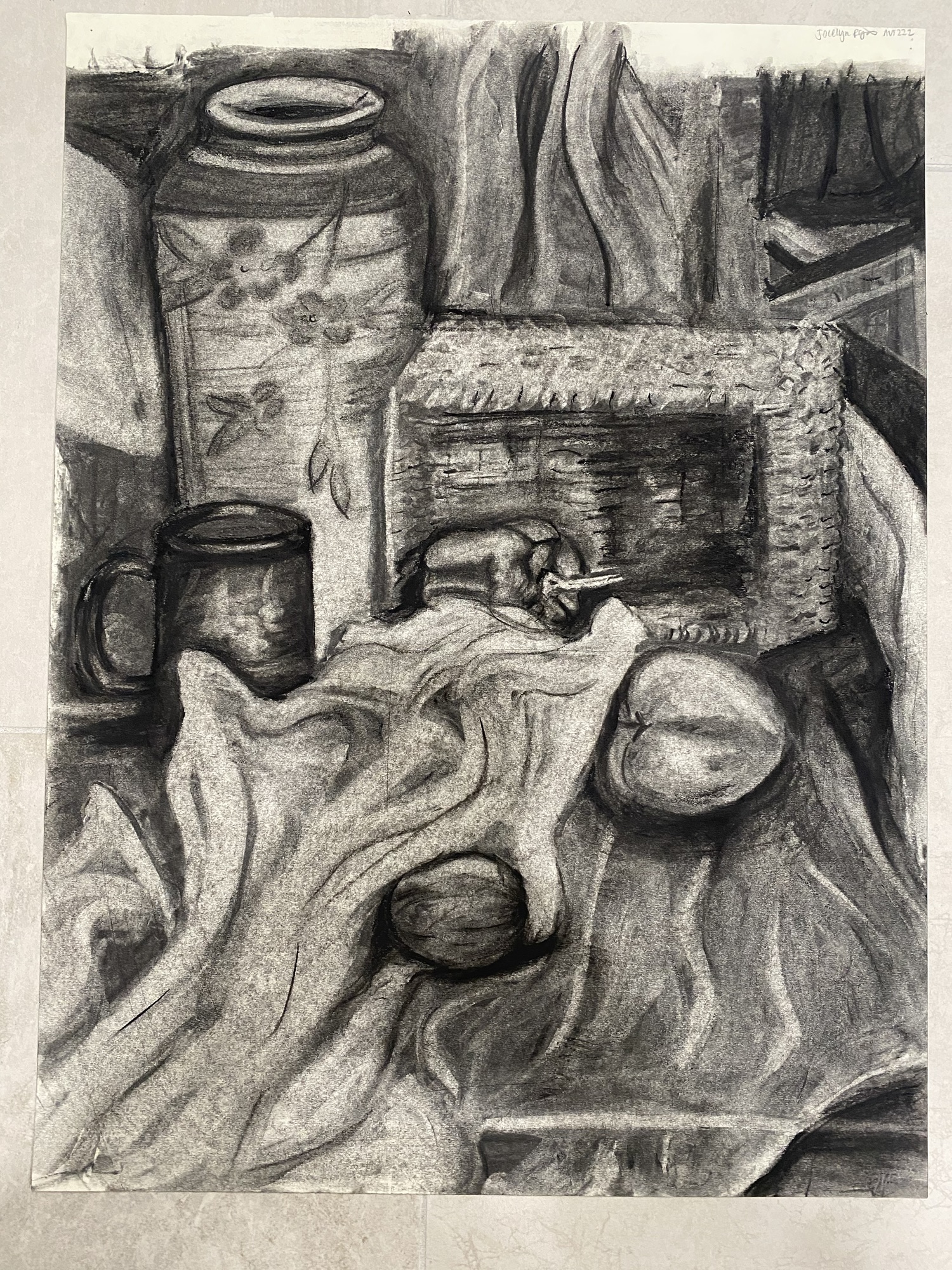
For my second studio exploration I decided to work with charcoal. While I have worked with charcoal before I have not experimented with different brands or paper and how they differ. One thing I did make note of when gathering materials for my exploration, while looking though what I already had, was that it can be difficult to distinguish what brand or softness of charcoal you have if you don’t keep them divided or they don’t have markings. I recommend having a paper to the side to do test markings before use, especially with willow sticks. I also learned there are different types of charcoal to work with as well as different brands. When shopping for charcoal pencils pay close attention to the label to make sure they are not graphite as some come in sets mixed with graphite pencils.

Types of charcoal: Vine Charcoal, Willow Charcoal, compressed charcoal, charcoal pencil, and pitted charcoal pencil.
- Vine charcoal and Willow Charcoal are slightly different: Vine charcoal is made from grape vines while willow charcoal is made from willow tree. Willow tree is more brittle but softer and easier to erase.
- Compressed charcoal is harder to erase than vine or willow charcoal because it’s darker and holds its form more. They also come in different forms. I used one that was round shaped and one that was square shaped during my exploration, but I think they can be found in pencil as well. I would use this type of charcoal for going over the darkest parts of my composition near the end.
- Charcoal pencil and pitted charcoal pencil are different in that the charcoal pencil works best for finer details and has a more smooth application, while the pitted charcoal gives more of a textured or expressive look. The pitted charcoal creates this effect because it doesn’t hold its shape as much as the charcoal pencils.
Note: I included conte a Paris Crayon in my exploration process although its not charcoal, because they are a common medium used with charcoal to add hue or highlight.


Brands and pricing
Whats nice about working with charcoal is that there is a wide variety of forms and price ranges that you can find them in, which are all relatively affordable. Because I was working with different variations of charcoal, it was difficult to compare pricing between brands. I have included a price comparison chart of three vine and willow charcoal brands. While they didn’t differ so much in price, they did come with varied amounts of sticks and diameters. I personally preferred working with Generals pure willow because of its tone, application feel, and how well it preformed using a range of techniques. I do wish that the generals pure willow had different diameters available within the pack like the Looneng willow sticks brand did. While the Winsor Newton Vine charcoal gave a more diverse range of pressure I don’t prefer working with them as much, because the soft, medium, and hard type of this brand look and feel similar and can be indistinguishable if not paying close attention. The Looneng Willow sticks not only came with a range of diameters, they also had the most sticks per pack. The portrait on my about page was made using the Looneng willow sticks and faber castel compressed charcoal. I would be happy to have a variety of these charcoal brands depending on what is on sale, accessible, and what effect I am trying to achieve in my work. I am interested in trying more brands to see if any others stand out but, currently, the brand I find most accessible is Generals. I think they are a good choice if you want to get used to something that is easy to find, mid range price, and high quality.
| Brand | Price |
| Winsor & Newton Vine Charcoal | $4.03 for 3, $7.59 – $12.59 for 12 |
| Generals Pure Willow | $7.96 for 5 |
| Looneng Willow Sticks (7-9 Diameter) | $9.99 – $14.99 for 25 |
Paper types
Charcoal can be used on smooth or textured art paper depending on the desired aesthetic and application preferences. I tested Sketch paper, colored Double sided honeycomb drawing and pastel paper as well as newsprint paper. while i really enjoyed working on the more textured paper because i feel like the charcoal set in well as was less dusty while working I did notice its harder to erase work and takes more time to apply to an area. I really want to do a portrait using toned/ colored paper but ultimately chose to do my final piece on the newsprint paper since it was the easiest to work on for me when it comes to shading and erasing.
Mark Making


Attributes / Limitations
- Charcoal can be very dusty and messy. I’ve had to rework areas that I’ve smudged with my hand, as well as wipe dust off my work with a chamois cloth.
- Requires more clean up.
- Charcoal doesn’t have a dry time like with wet mediums, so you do need a fixative to seal your work and keep it from smudging when complete. I would recommend not moving too quickly or close when spraying as I have gotten fixative drops on my work which stained the piece.
- Charcoal can stain. Wear clothes you don’t mind getting messed up and take precautions when setting up your work area. I set my work area up in my garage to avoid unwanted mess and stains.
- Charcoal is great for both precise work or expressive work and is great for practicing shading and observing light/shadow in a composition. I love the contrast that it enables you to capture.
- You are working with a limited palette without incorporating different mediums, like the conte crayons I mentioned earlier on. This can be helpful in cases where you are focused on practicing composition and contrast.
- It’s more portable in some ways if you aren’t worried about having to keep a range of colors on you. It can be a minimal medium to travel with for sketching.
- The material is small and light weight but fragile . I would use a hard shell container so they don’t get crushed and break.
- I think this medium can be used with any age, but due to how messy it is to work with, will be easier to do with older kids or adults. Requires extra prep and listening ears for younger kids.


Final Artwork: Julia, Charcoal on Newsprint paper
While I am still experimenting with charcoal, I do feel confident in using it and guiding others in working with it. This exploration process helped me to learn how to distinguish different forms of charcoal and how to pick each form based on my artistic goals in the future.
Additional Resources:
Hafeli, Mary Claire. Exploring Studio Materials: Teaching Creative Art Making to Children. Oxford University Press, 2015.


Leave a Reply