
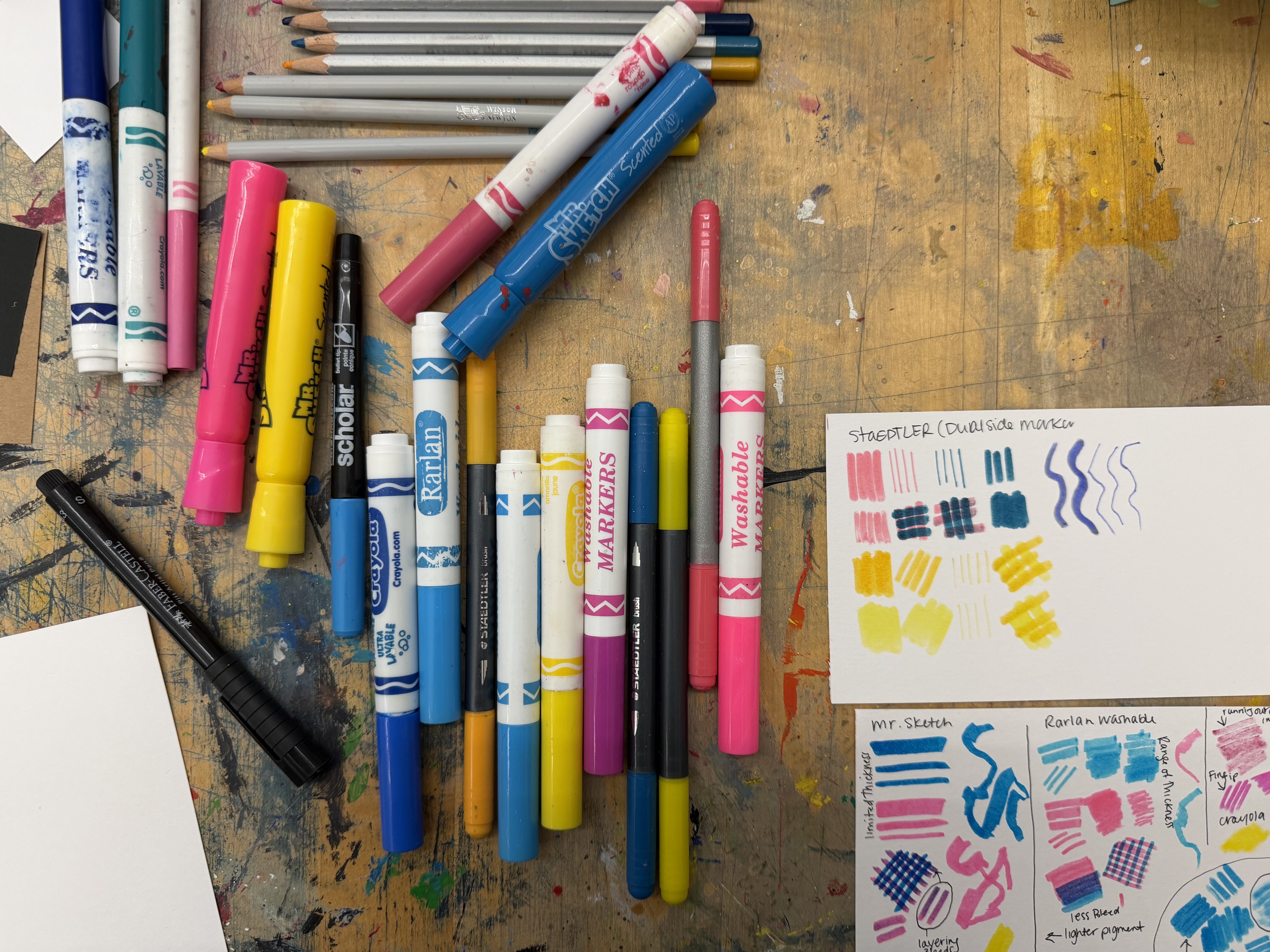

Markers are a beginner friendly art medium that is relatively affordable and accessible. Markers create vibrant colors which can vary depending on the brand set. One of their most appealing qualities is how easy they are to set up and clean up in a classroom because they don’t require many if any additional tools to be used.
“Markers and other fiber tip pens come in a wide range of colors and in many tip sizes and shapes. Across brands, inks vary in terms of color intensity and permanence, as well as type (waterproof, non-waterproof” (Hafeli).
Attributes of Washable Markers
Benefits:
- Mess free and Portable– Some markers art washable so are stain free, this medium doesn’t require many more materials to be used or set up and is easy to set out and clean up.
- Vibrate colors – choices of color palettes
- Range of sizes and styles – Varied width of tools for different grip and motor needs.
Considerations
- Limited color palette – Having a limited color palette can help avoid decision fatigue. Having a limited color palette requires more intentional planning of what colors to use can help create a more harmonious look.
- Brand Variation– Similar colors may appear different across different brands. I would recommend having scrap paper to swatch colors as you work on your project to ensure you are getting the desired color.
Challenges:
Tip contamination- Marker tips can pick up unwanted colors from nearby areas. For example, if you are trying to use a yellow near a darker color like blue or black the yellow tip might pick up that darker color, possibly smearing the a spot that you didn’t intend to. The scrap paper can be used to clear the tip, Just mark the paper until the color goes back to normal.
Dried up ink-Washable markers can dry up fast especially if they are left without their cap on for too long. There are videos i have found of how to rehydrate them by soaking them in water though I haven’t


After doing this study, I think markers are really great for fast color blocking. Because you can’t really blend this type of marker I used some cross hatching and stippling to create more values and texture. I relied more on my line work to create the shape rather than drawing and filling in the shoe.
Because marker use doesn’t require much setup, cleanup, or water, markers can be a good medium to carry as a color palette for quick sketching or gesture drawing. While not used in this study, pen can be used later to outline or create details after color blocking with the marker as a way of getting your values and shapes down quickly, then further defining your image. I find having a limited color palette to give an opportunity for more intentionality as well as unifying your work.
Differentiation
Because markers come in a lot of shapes and sizes, using different forms of markers depending on the child’s motor skills and grip is more of an option. When my son was a toddler and was able to use dot markers, which didn’t require as much motor skills because its more of a stamping motion than a gliding motion, though you can still glide it to create lines. For younger kids you can use the washable markers to prevent messes and stain while with older students you might experiment with alcohol based markers for more blending, layering and streak free art making.
Similar to pencils and pens, you can use grips with these markers to assist with handling.
Resources
Hafeli, Mary Claire. Exploring Studio Materials: Teaching Creative Art Making to Children. Oxford University Press, 2015.


Leave a Reply